Business3 minute read
AI no longer sets services firms apart, so buy the outcome you get to keep.
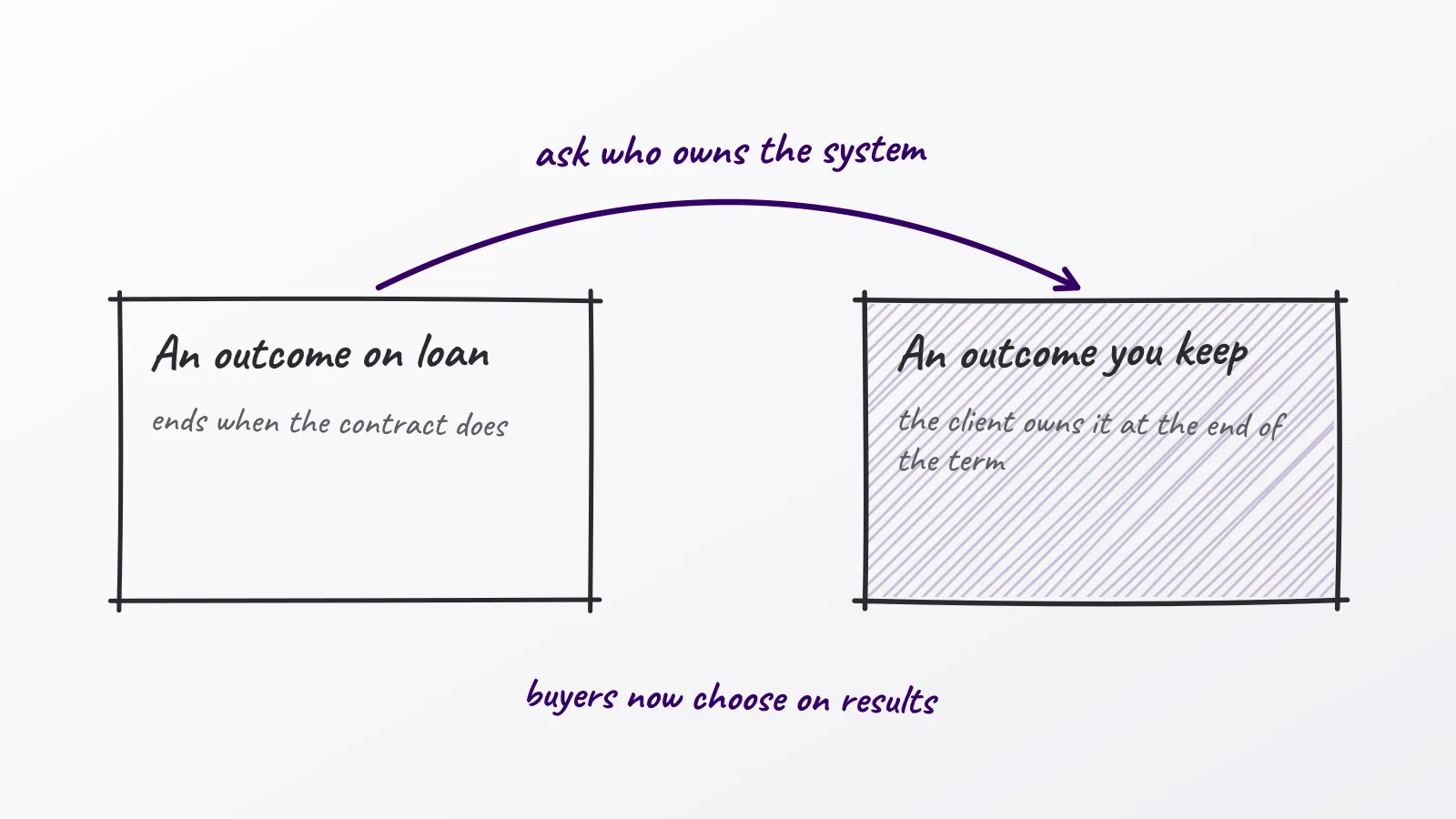
Buyers now choose services partners on results. For a growing company, the next question is who owns the system that produces them.
 Published
Business3 minute read
Buyers now choose services partners on results. For a growing company, the next question is who owns the system that produces them.
Published
Buyers now treat AI skill as a baseline and choose services partners on results, and providers are rewriting their contracts to match. A growing company should also ask who owns the system that produces those results, because a result that runs on someone else's platform ends when the contract does.
Key takeaways
Two years ago a services firm could get a meeting by saying its engineers knew how to use large language models. Today the claim is routine. Forrester reports that Cognizant plans to scale its forward-deployed team to 5,000 engineers and 10,000 business operators.
Buyers have run their own AI pilots by now. They ask what will change in the business and what they will have to show for it.
Forrester's October review of services earnings found AI-powered delivery established as the industry's service model, with leading providers repricing contracts to do more work with fewer people. A capability every provider offers gives a buyer nothing to choose between.
Among the 2,078 enterprise services decision-makers in Forrester's survey, 55% define a strategic partner by industry or domain expertise and 32% prioritize technology expertise. Forrester calls technology expertise and program execution the baseline. Its 2026 predictions add that fewer than a third of AI decision-makers can tie the value of AI to changes in profit and loss, and that CEOs will bring CFOs into AI approvals.
Most of these surveys cover large enterprises. McKinsey's State of AI 2026 shows smaller organizations further behind: 54% of respondents at organizations with $1 billion or more in revenue are scaling AI across the enterprise, against a third at smaller ones.
More than half of services decision-makers already use outcome-based pricing. Cognizant's chief executive describes the firm's direction as moving "from delivering projects to underwriting results." These contracts set how the partner gets paid and say nothing about who owns the system that produces the results.
If the operating logic sits on the provider's platform, the result lasts only as long as the contract. Forrester advises that when a deal includes a product and services, the buyer be ready to price them separately, so the service can end without losing the product.
Owning a custom system also means paying to run it. The best-known estimate puts maintenance at 40% to 80% of a custom system's lifetime cost, so a system without an accountable operator becomes a cost the business carries alone. Our article on managed care after launch covers the estimates. Commodity functions such as payroll are still better bought as software, and our build-versus-buy article covers where the line sits.
thinkOne pairs our forward-deployed experts with our agentic engineering and delivery platform. It works in six steps, from observing the work as it runs to operating the live system against an agreed number. Forward-deployed experts are now common across the industry, so what the work leaves behind matters. With thinkOne, we capture the operating logic in a model the business can read, and the system can run in the client's own cloud. At the end of the term the client owns the code, data model, business logic and data.
| Step | What happens | What the business gets |
|---|---|---|
| Observe | Experts watch the work as it runs, workarounds included, and agree with the client on the number the system must move. | A baseline set before any code exists. |
| Model | The operating logic becomes an explicit model of rules and decisions. | Leaders can correct their own workflow while changes are cheap. |
| Generate | thinkbridge generates working software from the model. | Expert hours go to judgment and edge cases. |
| Validate | The people who will use the system test it on real cases against the baseline. | Proof on the client's own data before launch. |
| Deploy | The system goes live, in the client's own cloud if the client chooses. | A system running in production. |
| Operate | thinkbridge measures results against the baseline and extends the system as the business changes. | Accountability that continues after launch, and ownership of the system at the end of the term. |
A family-run property firm shows what this looks like. Its portfolio of more than 90 properties, including residential units, storefronts, warehouses and land, ran on ledgers and spreadsheets checked from memory. Most off-the-shelf property software assumes one property type and a standard lease, and the family had no technology function to build its own. thinkbridge mapped the business process by process and built one system for the portfolio. It tracks each post-dated check through its full cycle and holds a bounced one open until someone signs it off. That level of detail comes from knowing how the family gets paid, the industry knowledge more buyers now put ahead of technology skill. The code, data and business logic belong to the family, and the system does not need a thinkbridge license to run.
Ask a prospective partner which number in the business will move, by how much in what period and who will own the system that moves it. A partner who answers in hours or headcount is describing effort.
Tell us what is holding your operations together. thinkbridge will show you what it looks like built right.